Image Map
Showing posts with label Science. Show all posts

August 27, 2021

Week 3 Reflections

This week seemed to be slightly easier because we are now in a routine. 

Highlights!


1. We started our new novel - Indian in the Cupboard. I love how this ties into our SS unit, and gives them a taste to learn about different Native Tribes, and then how that information connects to nowadays. We start our research team projects next week... 


2. I read Totem Tales to them, and then they created their own totem poles and tales. I used the clipart from here to make a small sheet to give them as ideas. 


3. We had a moment and did I wish my teacher knew… it’s sweet and heart breaking all at the same time. Man, I love these kids. Have you ever done "I wish my teacher knew...?" Basically I give them an index card, and they finish the sentence, then turn in.  I told them that it can be anonymous or they can put their names on it if they want.  They tell me information that means something to them.


4. We also tackled our Context Clue Travel Adventure! The foam flyers worked wonderfully as a mini STEM project to build, then sort the kids to mix them up a bit from their normal team groups before they hit the stations to review context clues.  

5. The kids got to attend music class for the first time in years. It was amazing and they absolutely loved it. And I loved the extra prep. :) It's amazing how much one can get done in a short amount of time... It feels good to tackle the to do list and actually get something accomplished.  


6. I read Noteable Notebooks. It's a great story to show pictures of real scientist notebooks.  

7. We also worked on our science observation note booking skills- working on those A,B,C,D’s. 
*Accurate
*Big
*Colorful
*Detailed 
This week we closely observed shells.  Last week we observed classroom objects, and the first week we observed rocks.  Our drawings are getting more accurate, bigger, colorful, and definitely more detailed. 


8. I ordered a bulk pack of ear buds for our class set of laptops.  This is the link I used, so far they are working great. It's helping now that I'm letting them use the computers more for Code.org, Scratch, and for Prodigy as a May Do.

9. We tackled a Growth Mindset Escape Room on Friday afternoon. This is the product I used.


It kept them moving and they needed to use that growth mindset because it was tricky! I ended up taking the 4 included puzzles and putting all 4 on a single page before I made copies for my class, it saved on paper. Then each table group had a specific task and code, and the kids rotated around to complete it all.

10. I taught them the game "Hello Mr. President". 
Hello Mr. President is a listening game, and it's quiet. Key word - silence... A kid stands in the front, eyes closed.  Silently, pick a second student to stand in the back of the room and say "Hello, Mr. President" - in whatever voice they want to use... kids get into the disguise. The "President" with their eyes closed has to guess the owner of the voice. For some reason the kids LOVE this game. 


11. The kids are reading!!! Silent Reading seems to be our favorite time of the day.  Kids are stretching out all over the room, in chairs, under desks, on the rug... I'm over in my chair also reading (currently Poison in the Colony), and there's a groan when we get to the point we HAVE to move onto workshop.  They love to read, and I'm getting to hear all about their books during our Book Talks.  Book Talks, with the 40 Book Challenge, and Book Beads are filling my time during Workshop.  It makes my day!

And now I'm ready to go curl up with my own home book... Have a great weekend!


Disclaimer - These are not sponsored links, just things that I LOVE and that I'm currently using in my classroom. I love to share ideas.  :)  

July 28, 2021

Our One Day Vacation

It's been summer break for 8 weeks, but we didn't really go on vacation until this past weekend.  Saturday to be exact.  Older boys had school through the end of June, hubby had work responsibilities, and then there have been a ton of appointments that we've tackled in July so weekdays just didn't work.  

But Saturday we went to Monterey.  Along with a ton of other people on the freeway.  Traffic was horrid.  Everyone was trying to escape the heat. 

It was over 100 degrees back home for the billionth time this summer, but Monterey was a nice 62. Lovely. We all even wore sweatshirts.  Absolutely wonderful.  

Anyhow, the main focus was our trip to Monterey Bay Aquarium.  We are members there, since it's actually cheaper for our family of 5 to buy the membership since we can go more than once during the year for the same price.  

I love the Monterey Bay Aquarium website for my classroom as well.  Have you ever checked out their website? It fits into our Life Science unit PERFECTLY!


Their EDUCATORS webpage has a TON of resources for us to use.  A lot of it is free.  


There are always kids in class that want to learn more about the animals and habitats, so the ANIMAL page has a lot of info for research.


But the LIVE Cam page is the absolute best for not just observation, but also for a calming background to present during a stressful test, silent reading in the Kelp Forest, etc.  There are a lot more options as well.  

I love being near water, the relaxation that takes over puttering around a town on the coast.  Thankful for our one day vacation.  

Hope you had a great summer! Next week is back to school - or at least all the meetings, and then kids show up on August 9th.  

Have a great day!

March 10, 2021

Earth Science and the Incredible Journey


After the move to 5th grade, I was in charge of the Earth Systems unit in our science rotation.  Those were the days, it was a wonderful plan. Each one of the 4 of us taught one of the science units for 7 weeks.  B was in charge of the Life Science unit, K was in charge of the Space Science unit, and J was in charge of the Physical Science unit. Our kids started with our own science, and then would rotate clockwise through the classrooms throughout the year.  It got them ready for middle school, switching classrooms, and having multiple teachers (and their expectations). It helped them be responsible. 

Then things changed and we all had to do everything at the same time because of a grant... Anyhow, now we all tackle the Physical Science unit first, then Life Science, then Earth, and finally Space.  There's some good stuff included in the units, it's just different...  


One of my favorite lessons to still make the cut is this Incredible Journey Game (aka Water Cycle).  When I moved to 5th the teacher that left had these cards in the file cabinet.  Thanks M! A little lamination and it's an instant game. 


B.C. (Before Covid and DL), I would have these all hung up around our classroom.  Students would use their notebooks and a dice, and go from card to card seeing where their water molecule traveled.  It was fun.  


Then I did it online... still fun, but not as much movement required. I had the students get out a board game that had dice inside.  The students that didn't have dice took 6 slips of paper and wrote the numbers 1-6 on one side and flipped them over to shuffle.  I put all these images into our meeting chat so they had ready reference.  


Then we all started with Ocean. How it works is that they roll a dice/choose a number and see if they get to move and where.  They realize that a percentage of rolls will put them in specific places and get stuck there... like in the ocean or in a glacier or ground water.  


They realize how animals are connected, and then they are grossed out about how an animal passes on the water.


They really enjoy this game, and I'm so glad that it worked out that they were able to do it this year. By just recording where they moved to and the exact movement that occurred, they were able to see the randomness of it all - that it isn't a pretty little circle.


  In the normal year we then take our information after, color code the 9 different locations and make colored strips on a piece of paper.  The colors told their water cycle journey, but kids also viewed it as art. 


Then they would take that story and write an actual narrative as to how that water molecule moved from one place to another.  It was always interesting how they would incorporate plants and animals, complete with dialogue... Got to love kids!


Anyhow, I highly recommend this game if you are teaching the Water Cycle this year.  :)  


July 18, 2019

Back to School: Setting Up Those Notebooks


Setting up those notebooks are a big task, but it's one that my class tackles the first week of school.  I really believe that my taking the time to do it all at the beginning, that it makes it easier to keep it organized the rest of the year.

For years I had 5 notebooks per student.  Reading, Writing, Math, Social Studies, and Science.  I was happy with that for years, other than there were still a lot of empty pages at the end of the year... Then switching to 5th grade I decided to try and only use 4 notebooks to see if I could get away with it, and it worked (plus it's cheaper)!

The last 2 years we have used four notebooks - Reading/Writing (we just call it ELA and divide it in half), Math, SS, and Science.  The first time we pull out the notebooks, we start out labeling the front covers and pulling out the highlighters.  That's something that I do - every student has a set of multiple colors of highlighters.  It's important to me to have different colors for different purposes.

Each notebook gets its own color highlighter.  I used to stand in Walmart during the back to school sales counting out 35 of specific colors (32 kids plus a couple of extras if kids move and come).  Then I realized that I could order them for about the same price through my district warehouse - the con is that they are all Black and White covers and look exactly the same.  To solve this issue, the kids take the specific color (that we all have only that one out) and holding the book closed, color the bottom of the notebook pages to be that certain color.

Last year:
Math - purple
ELA - green
Social Studies - orange
Science - blue

It really doesn't matter what color, as long as EVERYONE has the same color.  Looking in their desks they will be able to see that color easily and can pull out the correct notebook in record time.

Math Notebook - This is the notebook that we don't do much in until we are actually making the pages together throughout the units.  We do write in the Math Practices, a problem solving acronym, and this year I want them to also to write out a multiplication chart (they can do it by memorization and by using their table if they need).  Then the rest of the book is set up by units.

ELA - like I mentioned above, this notebook I let the pages fall down the middle.  The beginning half is our Writing/Grammar focus, the back half is all about Reading.  At the beginning of the year we go page by page (mine under the document camera) writing the headings for each page.  That's it, only the headings.  Everyone is literally on the same page, and it helps down the road when it's time to go back and fill in those specific areas with our brainstormed anchor charts.

Writing/Grammar:
The first pages we have the following:
-conventions that 5th graders are expected to ALWAYS use
-2 pages each (double spread) for each type of writing they are expected to master: Narrative, Summary, Informational, Research, Opinion - we go back to draw in graphic organizer examples
-one page per part of speech
-one page per type of figurative language
-then the rest of the Writing pages are for our weekly Mentor Sentences (they don't fill those in at this point).  Each mentor sentence needs a double spread.

Reading:
The back half of the book has the same type of thing - page by page, just the headings:
-Book List (this is where we write all the books that we read together both Mentor Sentences, Read Alouds, and Class Novels) - needs 2-4 pages
-Each genre gets it's own page.  We go back later to add definitions and specific examples/opinions.
-one page per comprehension strategy
-one page per text structure
-half page per common theme (I've tried it with quarter pages as well, it works UNLESS the kids write huge.)
-when we did AR the kids also had a running list of books they read by themselves and would make checkmarks when they had taken a test, nowadays they just keep track on their 40 Book Challenge paper (that is kept in their classwork folder).
-In the very back of the notebook, we take the last 5ish pages for our academic vocabulary words.
-Most novel work is done outside of the notebook when we do Novel Notes (in addition to the novel vocabulary words), but I do add at least a little bit into the notebook so the kids can see their own growth as a reader.

It's free if you need it! 

Overall, I love having both in the same notebook.  It's a ready reference that they really do refer back to.

Science and Social Studies: Both notebooks don't really get started until the first units (later on in the first/second week), but here's the quick run down.  In both subjects, I try to implement a lot of GLAD strategies.  When we start a unit, the kids write the unit title in the middle of the page in that specific notebook.  I have related images (just found on Google) that I have printed out and have sitting around the room, and the kids wander around making observations and wonderings in their notebook on that initial unit page.  They then head back to their groups to brainstorm and make a long list of both, then we share full class.

Each unit also has a vocabulary page where we continue to add content vocabulary words throughout the unit.

For Social Studies we make a 4 square for each article we read (in addition to the close read highlighting we do on the article):
-Important Dates and what happened
-People and Places mentioned
-Main Idea(s)
*4th quadrant - I choose one of the non-fiction comprehension strategies to focus on.

For Science - we add the NGSS Science Practices and the Cross Cutting Concepts at the beginning of the notebook, and a list of Science Sentence Stems for our discussion.  We refer back to them to see where each activity lines up... I think it helps kids to see the purpose.

Woah - another long post.  I hope this helps someone.


February 4, 2017

I Graduated from GLAD!

Have you heard of GLAD training?  I just finished 10 days of training this year.  The last 4 days we have been in a model classroom in the mornings, watching the trainers go through an American Revolution unit with the kids.  

Three reasons why I LOVED this week:
1) I learned something new.
2) I was able to see my kiddos from last year.
3) There were 4 days of prep time in the afternoons, complete with free color printing, posters, and lamination.  

Today I wanted to share some of my pictures from the week.  So many interactive charts, the butcher paper was literally falling off the walls.  Not everything, just the things I really wanted to remember.  


On the last day, the trainer met with small groups.  The first two groups were on level kids, so they read informational passages and did a jigsaw activity.  The third group was an ELD group, which went through a narrative (lots of pictures on a chart, the story on the back) and then each student had to add a sentence after the topic sentence prompt.  


These inquiry charts were added to every day for 4 days.  The kids asked a question, and the trainer didn't answer them, but had them add it to the chart.  There was an opportunity every night for students to choose a question from the chart and do research to find out the answers.  LOVE it!


I want to remember that poems/chants are NOT just for the primary grades.  Back when I taught 2nd grade, I would always have a Poem of the Week to practice for fluency.  Well I learned that poems can be used to teach vocabulary in the upper grades.  The chart started off nice and BW.  Then the kids had an activity to stand up and shout it out.  Afterward, the trainer asked kids what words they thought were important and highlighted them, then added some illustrations and picture file cards to help bring the poem/chant alive.


The kids created this timeline, and it expanded over two days.  The first day was only the last half of it, just the words, the second day the kids reviewed it, added pictures and vocabulary words, and then found more information to add more events to the front of it.  I've always had a CA timeline, but never thought to add pictures as we walk through the story.

There is so much more that I'm still pondering how I can add it to my classroom, and honestly there are tons of units out there for almost every part of my Social Studies and Science standards (just google GLAD units 4th grade), but here's what I came up with at this point in time.  Check out the links to grab them from Google Docs.  :)

Home/School Connection - The kids take a sheet home, talk to their parents about what they learned, and write about it on the back.  They get a parent signature and can earn some points for their team if they choose to do the assignment.  The real GLAD units usually have specific questions to talk about, but I wanted some I could use anytime to review.  These are for Fourth Grade California Social Studies and NGSS units.   


Caught You Cards - These are inspired by GLAD's literacy awards.  Basically during direct instruction a teacher is busy teaching :), so you choose two helpers that are your scouts.  You tell them to pay attention to the other student's behavior, something specific like active listening, eye contact, participation, etc.  After the lesson you ask the scouts which kids demonstrated those qualities, and they can give an award to them.  The kids are recognized for doing a great job, and then they have a choice to do an extra activity for a reward.  Those rewards don't have to entail anything more than giving some team points, or a spot on the raffle.  These Caught You Cards are for Social Studies and Science - research options and STEM.  :)  


Oh, Research!  How I love thee... Well, with all the research options they had, the kids need a little help with organizing their thoughts.  The focus with research is that it is taking a question from the unit, and learning how to cite a source. Here's a little sheet. 


Okay - last one for the moment...  There are tons of anchor charts that the trainers used, but I was drawn to something similar to this... It's called a Mind Map.  Students record information on it from all the many informational passages, timeline, narratives, pictures, etc. that they learned from the week.  I love the fact that it's a way to culminate everything.  


I hope these help you.  There are still tons more that I want to recreate for my classroom.  I'll check back in another time.  Hope you are having a great day! 

January 13, 2017

Earthquake Challenge


We have started our Rapid Changes to Earth unit.  Oh, how I LOVE this unit.  The kids are so engaged, and there are so many hands on activities to complete.  This past week we started studying earthquakes.  Living in California, it's one of those things that we are used to hearing about.  We have prior knowledge and a bunch of connections... like the ones that we just felt during Christmas break.  Well this year I decided to use wooden blocks to have the kids try to design buildings that could withstand movement.  I hope the movies work, I love watching the kids problem solving, but also to hear them share their joy.  :)    

So Much Fun


Students worked with a partner to form a building on two "plates" - actually two books.  It needed to be able to have those plates move in 3 different ways while still remaining intact - sliding, pushing/pressure, and separation.  There were tons of laughter and problem solving at the same time.


We still have more to learn before we move onto Volcanoes, but the interest level has been piqued.  


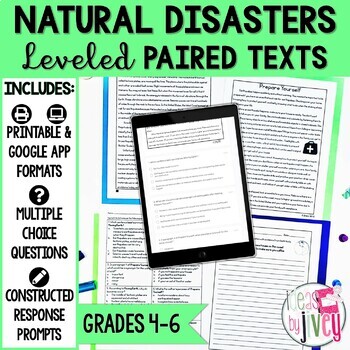
Next up my students will be reading Jivey's Paired Texts on Natural Disasters.  

Paired Texts / Paired Passages: Natural Disasters Grades 4-8

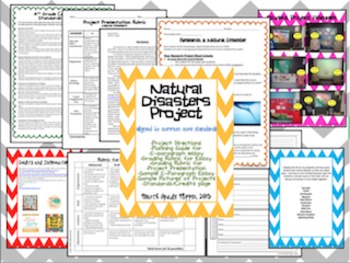
She covers Earthquakes, etc.  and then I will assign their Natural Disaster Research Report from 4th Grade Flipper.  

Natural Disasters Project Editable Nonfiction Writing Task

The Paired Texts give that deep knowledge that our text lacks, and the research is giving the kids choice, which ups the interest level.  How have you studied earthquakes?  

January 7, 2017

Fly Like an Eagle...


Over Winter Break I fell in love with a little eagle family over on the Dick Pritchett website - a live Eagle Cam.  Eagles have always been special to me, maybe because they have been every mascot in the 4 schools I have worked at, or maybe it's because of what they represent, or specific facts about them, but I fell head over heels in love with them....


When I first tuned in the expectant parents were busy taking care of their two eggs, about to hatch at any moment... which I then learned "at any moment" was actually three days later on New Years Eve.   After investing days of tuning in, when school started back up I decided to bring them with me.


It was a very powerful motivator this past week in my classroom.  Students were trying to earn extra points in order to take a peek at the new eaglet.  We watched as a class as momma fed her baby some fish, they made inferences as to where dad was at the moment and why baby needed to snuggle up close to the parents.  


I wanted to share, just in case you didn't know about the website.  I'm hoping they leave the cameras on in the coming weeks to watch baby grow up.  If not, well there are other Eagle live cams out there.  :)  

I hope you have a wonderful night.

December 15, 2016

Rocks and Minerals


I love teaching about Rocks and Minerals.  I have a side table set up with magnifying lens, rocks to sort, charts to help categorize, read alouds for silent reading time... It's such a hands on time.  I wanted to wrap it up in a fun way too.  


My teammate found a Dice Simulation activity from Teaching in the Fast Lane that was about the Rock Cycle, so I decided to buy it too.  I'm so glad I did!  I had tried her Explorer Dice Simulation, so I was already convinced of the process - 6 stations, and at each station the kids roll the dice to see where they would move next.  I printed off the stations, laminated the sheets, and then used bright sharpie to circle the process to get to the next rock.  

my whiteboard example - I love moving around the room to show the kids how to complete it

As the kids went from station to station they needed to record both the process and the rock they ended up at.  We went 20 rounds that first day as they recorded on the included sheet.  This was the Wednesday before winter break, so the kids were VERY ready to be up and moving, using up some of that extra energy.  :)   

found the beads on Amazon - since it's the first year doing this I chose a multi color bead box for $10

The next day we took out our recording sheets, and at each rock station I placed a certain color pony bead in a tub.  On my front table I placed all 6 of the process beads (again, one color per container).  Each student took a pipe cleaner, and walked through their recorded rock cycle, adding the rock bead, process bead, rock bead, process bead, etc.  We stopped as a class every 5 beads and took turns telling the rock story to partners and to ourselves.  I kept track of the amount of beads on the board.  The pipe cleaners held about 31 beads before we decided to call it a day.


Back at their desks, the kids had the opportunity to use the doc camera to share their rock story with the class.  Most of them could share it without using their paper by this point, they just needed to look at the beads to share rock, process, rock, process... It was an activity that I will definitely do again!