Image Map
Showing posts with label Task Cards. Show all posts

July 2, 2019

Let's Talk about Games


I've always loved using task cards in my classroom - I jumped on that bandwagon years ago.  I use them for intervention, for review, for centers, for Scoot, etc.  Something that I've added to that list the last couple of years is using them in conjunction with interactive kid games.  That's a way to bump up engagement.

It's also only a special treat.  I only do this for review times, not for the everyday math lessons (we have other games/activities for those).  I want kids to have a foundation before they are having to multi-task.  Sometimes I'll add one of these games into a center rotation, but that's pretty unlikely as I won't be able to monitor as much when I'm working with my own group.  The focus has to stay on the math skills, the games are just the fun vehicle.   


Kerplunk

 So here's the breakdown of what I've tried:

Kerplunk - I have one giant game.  It's actually a pain to set up, but the kids love it.  I got it on major sale after Christmas one year.  It also takes a long time to reset the game, so when it's up I try to use it for many different things. 

I have used it for Classroom Management (Head Over Heels for Teaching idea) - where a hard working kid gets to pull a stick.  When the balls fall the entire class gets a reward.  

***With TASK CARDS all these games pretty much have the same routine:

1.  The player or team chooses a task card and EVERYONE solves it.  

2. The player checks their answers against every other player's answers, and they see if they match.  If they do, they notice the different ways they have solved the problem (what different strategies did they use) - using a number talk format.  

3. If they don't have matching answers, then they still have a conversation and teach each other how they did the problem, usually errors are figured out as to why it was the wrong answer (error analysis). 

4. At the very end, they can check their answer on the answer key, then the player gets a chance to play their turn (even if they got the math problem incorrect).  

Connect 4
The last couple of years I have only had one game of Connect 4.  It's on my list to get a couple more sets since the kids love it so much.  It's also good for rainy day games, since it's a quick reset.  They play similar to above - but are working in teams to choose the math problem and to place their game pieces.  Since it's a faster paced game, I have each member of the team get their own piece (so 2 pieces are played at a time).  Everyone still solves the problem, everyone still takes part in the discussion.

Basket Case
 Basket Case - My grade level has a couple sets of these in the workroom.  It's so much fun and the kids have a blast.  It's a quick set up, but there is definitely more skill involved with that pesky hand-eye coordination. Lots of laughs with this game.  Same idea as to how to play using task cards.  They all solve the problem, they all have those conversations, then the person who has it on their head is the one tossing the ball into the air and trying to catch it.

Jenga
Jenga - I actually have 8 sets of these in the classroom.  You probably do not need one for each group of 4, but they have come in handy over the years.  Sometimes we have an entire room of Jenga going at a time.  It does take a little bit of time to reset, little sand timers help with having the kids reset quickly.  If you are doing these on desks, I've found it's faster to use a small tray under the game so that kids build on that.  It seems to help when the blocks fall so they aren't falling all over the place.  

*Not pictured but other fun games:
-Battleship when learning coordinate graphs.
-Dominoes (not played traditional way) - the kids add a piece vertically to a growing trail, and then at the end the players knock the pieces to let it fall.  
-Board Games (Chutes and Ladders, Checkers, Candyland, etc)
Same idea with all of these - kids play a round after they've done the work.  

I hope this helps someone.  Try to add a game next year, your kids would love it!

January 8, 2014

How I Use Task Cards

You probably can tell that I use task cards a lot in my classroom.  I wanted to share all the ways that my students work with them.  

Math and Reading Workshop


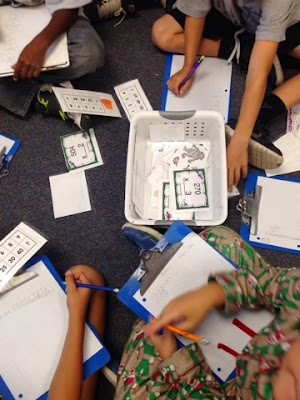
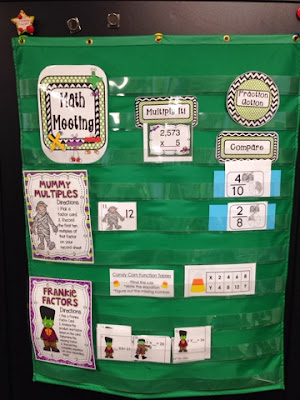
During workshop time, students work individually and with partners to practice skills.  I put them on a hanging pocket chart, or in a basket - and students answer on scratch paper.  They then turn it in so I can check their work, and it keeps them accountable for participation.  

Morning Math Meeting

During our morning math meeting, students solve 4 or 5 task cards of different skills as review, and another couple new skills that we are about to tackle.  It's a constant spiral for them.  I love how I don't have to brainstorm a bunch of different equations every morning, and my student helpers are able to change out the cards at the end of the day.  

Scoot Game

There are many different ways to play Scoot.  One way is having each child have a card on their desks,   each child having a paper & pencil, and then after a minute of work time tell them to scoot to the next desk to solve the next card.  This way usually takes my class about 45 minutes to an hour to go through 32 cards.  


I don't usually have time to do the entire class rotation though (all 32 cards), so I have students place a card on their desk, give them a minute to solve on scratch paper, and then tell them to find a new desk.  They are hopping all over the place and we tackle about 2/3 of the cards.  Afterwards I have them meet with a partner to discuss their answers, and then I collect the papers.  This way I can then stick the cards into a workshop rotation and there are still some "new" cards that they kids haven't done yet, with the other ones being review.  This method usually takes my class about 30 minutes.  

On days that I have an even smaller amount of time I have the students place the cards on the desks, give them a scratch paper, and time them for 15 minutes.  It's a challenge to see how many they can accomplish during that time.  I usually do this type of thing with multiple choice answers.  

Small Group Intervention

When I have a small group that needs to work on a specific skill, I usually pull out some task cards and bring the kids over the carpet.  Somedays I use task cards during my small group teacher lesson as our problems to solve.  I love how laminated task cards have replaced a lot of my paper and pencil review sheets (which has saved me tons on copies).  The kids bring their whiteboards over to the carpet area and we go through the problems step by step.  

Parent Intervention

I am blessed to have parents that want to work in my classroom.  When they come to visit, I just leave some task cards in a basket on the table, a big whiteboard, marker, and a list of students to call to work on specific skills.  They use the cards as problems to work on.  It makes it easy to prep for the helpers. 

There really are so many different uses to those laminated cards.  I absolutely adore them!  

Do you use them too?